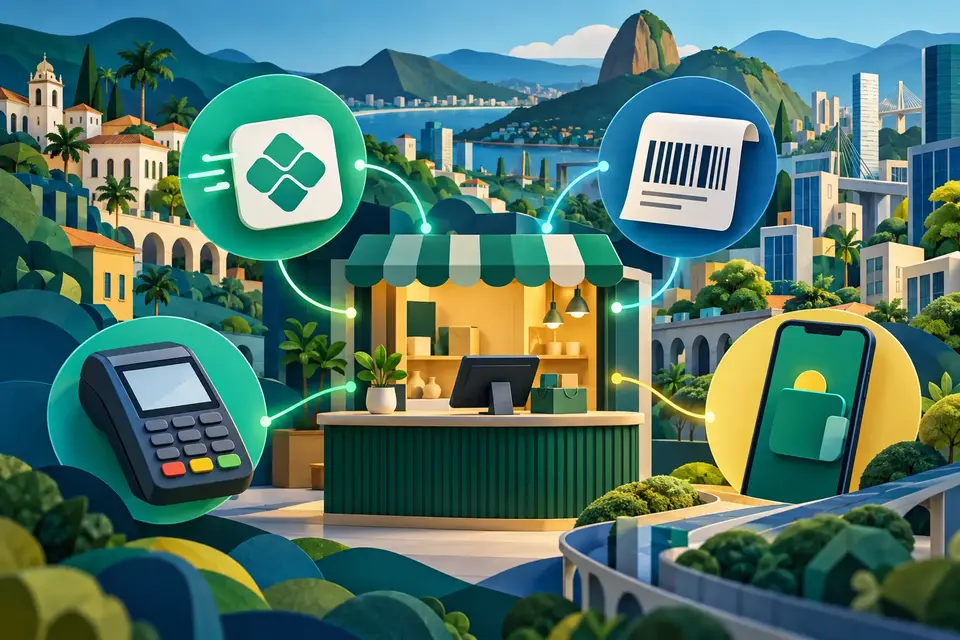
Brazil’s payment landscape
Brazil combines a large card market with one of the world’s most heavily used instant-payment systems. Banco Central do Brasil reported that Pix was the fastest-growing non-cash instrument in 2024 and represented 47% of non-cash transaction volume in the final quarter. Cards remained important: credit, debit and prepaid volumes all grew during the year. That mix means a merchant should not frame Brazil as a choice between Pix and cards. The practical task is to present the right methods for the customer journey while reconciling each rail on its own terms.
The Central Bank describes Pix as available for person-to-business and business-to-business payments, normally initiated through a bank or payment institution using an alias or QR code. It also confirms that traditional instruments such as boleto and cards continue alongside Pix. Actual merchant availability depends on the provider, legal entity, sector, channel and integration. Inclusion in this guide is therefore a description of the local landscape, not a statement that FixPays or any particular provider supports every method for every merchant.
Pix for immediate merchant payments
Pix can support physical and ecommerce checkout through static or dynamic QR codes, Pix keys and copy-and-paste codes. For automated commerce, a dynamic charge identifier and provider callback are more reliable than asking customers to upload screenshots. The merchant ledger should record the charge identifier, expected amount, payer status, receipt timestamp and any return. Order release should follow a verified provider message or query result, not the visual appearance of a receipt.
Pix Cobrança extends the rail for immediate and future-dated collections. Banco Central do Brasil contrasts its instant, continuously available settlement with boleto compensation. Merchants can attach billing information and use the Pix API to generate QR codes and automate reconciliation. They should still define expiry, partial payment, duplicate payment, refund and exception procedures. Instant movement shortens the operational window; it does not remove fraud review, customer-service responsibility or the need to match money with the correct order.
Recurring payments with Pix Automático
Pix Automático allows a payer to authorise recurring collections once and manage that permission through the payer’s financial institution. The Central Bank lists uses including utilities, schools, gyms, condominiums, subscriptions and insurance. For a merchant, the important object is the mandate: when it was created, the permitted amount, the collection schedule, current status and cancellation. A recurring billing system should not treat an expired or revoked authorisation as an ordinary payment failure.
Before offering the method, test pre-notification, insufficient funds, resubmission, cancellation, refunds and plan changes. Keep the service contract separate from the payment authorisation so support staff can explain whether a subscription ended, a mandate ended or only one collection failed. The Central Bank notes that receiving businesses may be charged by their payment service provider, so commercial evaluation must use the provider’s actual proposal rather than assume a universal Pix price.
Cards, instalments and wallets
Brazil has a substantial base of active credit, debit and prepaid cards. Credit cards can be especially relevant for ecommerce, travel and higher-value purchases, while local instalment practices may influence conversion and cash flow. A merchant considering instalments should confirm who extends the credit, when the merchant receives funds, how fees are shown, how refunds are allocated across instalments and what happens when an order changes after authorization.
Digital wallets are an interface, not a single settlement method. A wallet may use a stored card, balance or bank-connected rail. Merchants should identify the underlying instrument, authentication path, descriptor, dispute process and refund destination. The same wallet name can behave differently across providers or channels. Tokenisation and mobile authentication may improve experience, but they do not replace clear evidence connecting the payer, order, authorization, fulfilment and customer communication.
Boleto and bank transfers
Boleto is a standardised payment order within a scheme instituted by the Central Bank. The official FAQ says a boleto must follow the prescribed model and be registered in the centralised collection base. It carries payer, issuer, beneficiary, amount and due-date information. Compensation can take business days, so merchants need explicit rules for inventory reservation, price validity, expiry and order cancellation. Confirmation should come from the receiving institution or provider, not merely from a customer-supplied document.
TED and other bank transfers can remain useful for certain business or higher-value flows. Compare them with Pix on availability, timing, reference data, return procedures and reconciliation. A manual transfer to a bank account can create support work if the payer omits the reference or sends the wrong amount. Where a provider offers a structured transfer flow, test how unmatched funds, overpayments and refunds appear in reports.
Merchant comparison and rollout
Choose methods with evidence from the target customer segment, not a generic national ranking. A subscription business may value Pix Automático and cards; a one-time ecommerce sale may need Pix, card and boleto; a B2B invoice may require Pix Cobrança or a transfer workflow. Compare completion, time to usable funds, total cost, fraud exposure, dispute model, refund speed, reconciliation quality and support demand. Evaluate domestic and international customers separately because issuing, currency and authentication conditions can differ.
A controlled rollout should start with clear eligibility confirmation from the provider. Document the contracting entity, settlement account, supported currencies, transaction limits, prohibited uses and operational contacts. Use a test plan covering successful payment, timeout, duplicate callback, underpayment, overpayment, cancellation, partial refund, full refund and provider outage. Keep customer wording limited to methods that are live for the merchant’s exact checkout.
What it means to Merchants
Merchants entering Brazil should treat Pix, cards and boleto as complementary rails with different confirmation, cash-flow and customer-service characteristics. Map the intended customer journey first, then confirm method and sector eligibility with FixPays or the relevant provider before making an integration claim. Build reconciliation around authoritative provider events, maintain a tested refund path, and review the mix using completion, usable-funds timing, exceptions and total operating cost. This guide describes the Brazilian market and does not promise that every named method is available to every business.