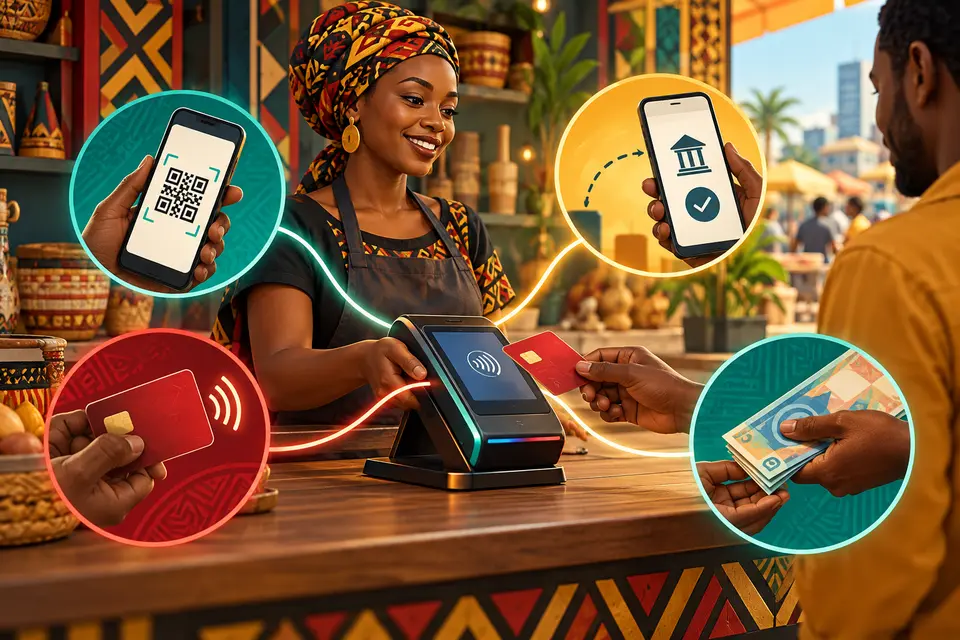
Angola’s payment landscape
Angola combines cash with a domestic shared card network, mobile channels and interoperable bank-payment infrastructure. EMIS says it manages the MULTICAIXA network and Angola’s Automated Clearing House, including card management, credit transfers, cheques, direct debits and instant transfers. Settlement of clearing positions is handled by Banco Nacional de Angola. These systems have different purposes and should not be presented as one interchangeable checkout method.
This guide identifies major documented payment routes rather than claiming exhaustive coverage. Actual acceptance depends on the merchant entity, business model, customer, currency, bank or payment provider, technical connection and current rules. FixPays can assess a merchant request, but the presence of a method here does not establish an integration, guaranteed acceptance or regulatory approval.
MULTICAIXA cards, terminals and ecommerce
EMIS describes MULTICAIXA as Angola’s national and universal card-payment subsystem and shared acceptance network. It covers ATMs, physical payment terminals, virtual channels and connected banking services. For a merchant, the relevant question is the contracted acceptance product: participating acquirer, terminal or online channel, supported credentials, transaction limits, settlement account and refund capability.
At a counter, staff should release goods only after a trusted terminal approval and retain the merchant reference that reaches the settlement report. A timeout needs a status check before another attempt. Online, EMIS defines the Gateway de Pagamentos Online as a virtual channel that can implement terminal functions in a merchant service. Confirm onboarding, authentication, callback integrity, reversals and refunds before advertising availability.
MULTICAIXA Express and QR journeys
MULTICAIXA Express is a mobile channel that associates eligible bank cards and supports functions including payments, transfers, service payments and authorisation of online purchases. EMIS also explains QR payment at a merchant terminal. This is a customer interface around participating payment infrastructure; it does not mean that every merchant, card or website is enabled automatically.
For a QR journey, prefer a provider-generated reference that binds the order and expected amount. The merchant system should wait for an authoritative provider event or query result rather than a customer screenshot. Define pending, successful, failed, reversed and refunded states. Test what happens when the customer authorises but the browser closes, the callback is delayed or the same code is presented twice.
KWiK instant payments
EMIS describes KWiK, or Kwanza Instantâneo, as an Angolan payment instrument for instant transfers and payments at any time between accounts at participating banks or mobile wallets. EMIS reported more than five million instant transfers worth Kz 135.15 billion in September 2026. Those system statistics show active use; they do not predict conversion or establish merchant eligibility.
A merchant considering KWiK should confirm participant reach, how the customer selects or scans the beneficiary, limits, confirmation data and refunds. Instant movement reduces waiting but does not eliminate wrong-recipient, duplicate or fraud risk. Use a stable order reference, prevent duplicate fulfilment and document whether a return is a reversal within the scheme or a separate transfer.
Bank transfers and direct debit
EMIS says the STC credit-transfer system moves funds electronically from the ordering customer’s institution to the beneficiary institution and operates clearing sessions for transfers within the limit set by the central bank. Merchants access this through participating banks, not directly through the clearing infrastructure. Ask the bank which product uses the rail, which references survive, when funds become usable and how rejects or returns appear.
EMIS also lists a direct-debit system within the automated clearing house. A business considering collections should confirm the creditor agreement, customer mandate, submission timing, rejects, cancellation and applicable refund rights. Keep termination of a service contract separate from cancellation of a payment mandate, and do not continue a debit after authority has ended.
Cash, comparison and rollout
Kwanza cash remains relevant for face-to-face commerce and customers who do not complete a digital checkout. It needs separate till, receipt, security, deposit and counterfeit-control processes. Finance should not combine cash, card settlement, KWiK confirmation and bank transfers in one generic paid status. Each route needs its own authoritative evidence and refund method.
Build a provider matrix covering the legal entity, approved activity, methods, customer markets, currency, limits, settlement destination and support contacts. Test successful payment, decline, timeout, duplicate attempt, cancellation, partial refund, full refund and reporting export. Compare completion, time to usable funds, direct charges, exception work and customer support. Confirm every live method before showing it at checkout.
What it means to Merchants
Angola offers a domestic mix of MULTICAIXA cards and terminals, MCX Express, KWiK instant payments, bank transfers, direct debits and cash. Merchants should identify the underlying rail, contract the correct merchant product and build fulfilment around authoritative confirmation rather than screenshots. Keep method-specific reconciliation and refund procedures, verify customer and sector eligibility, and retest after material changes. This guide describes the market and does not promise that FixPays or any provider supports every named method for every business.