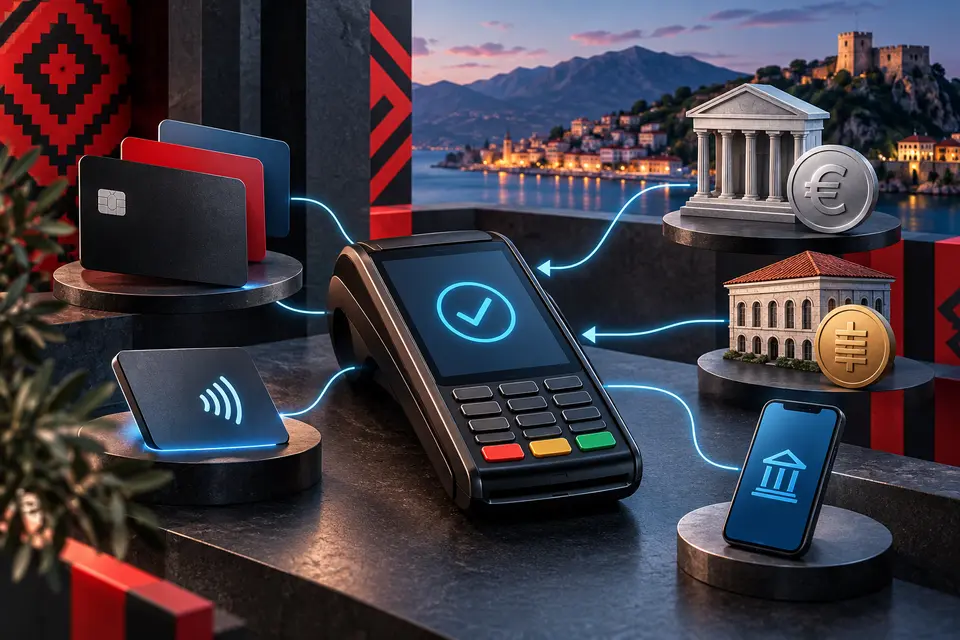
Albania’s payment landscape
Albania combines a growing card market with domestic bank-transfer infrastructure and operational participation in the Single Euro Payments Area. The Bank of Albania reported that cards accounted for almost 64% of payments through banks in 2024, with card-payment volume increasing 26.3% year over year. Debit cards represented most active cards. The same central bank operates the AIPS large-value system in lek, the AECH retail clearing house and AIPS EURO for domestic euro customer transfers.
This guide describes major relevant methods rather than claiming every product is available to every merchant. Actual acceptance depends on the contracting entity, business model, customer location, currency, bank or payment institution, acquirer and technical integration. FixPays can assess a merchant request, but the presence of a method here does not establish an integration, guaranteed acceptance or regulatory approval. Confirm the current provider scope before displaying a method or committing development work.
Cards and contactless acceptance
The Bank of Albania’s 2024 payment-systems report counted more than 1.5 million active cards and said debit cards dominated the mix. Nine banks were licensed as card acceptors at year end. For ecommerce, a merchant should still confirm which domestic and international brands, issuers, currencies and authentication paths its own acquirer supports. A national card count does not establish online acquiring coverage, and a card issued in Albania may behave differently when the merchant entity or settlement account is elsewhere.
Contactless cards and mobile wallets can improve face-to-face speed when the terminal, issuer and scheme support the transaction. A wallet is an interface around an underlying credential rather than a separate settlement promise. Merchants should identify the tokenised card or account route, test refunds to the original instrument, and retain the terminal and provider references needed for support. Staff should know what an approved, declined or uncertain terminal status looks like before releasing goods.
Domestic lek and euro transfers
AECH clears small-value retail payments in Albanian lek, including credit transfers and direct debits, in clearing sessions. Its net positions settle through AIPS. A merchant using a bank transfer product should obtain the current cut-offs, value limits and expected confirmation from its bank. Order matching depends on stable beneficiary and reference information. Screenshots or customer messages are not authoritative evidence that funds reached the merchant, and manual transfers need a process for wrong amounts, missing references and duplicates.
AIPS EURO provides real-time gross settlement for interbank customer payment orders in euro within Albania and operates through participating banks during stated hours. It is financial-market infrastructure, not automatically a consumer checkout method. Merchants should ask their bank which customer product exposes the rail, what fees and cut-offs apply, and how the transfer appears in statements. Domestic euro payment and cross-border SEPA payment should remain distinct in customer instructions and reconciliation.
SEPA and cross-border euro payments
Albania became operational in SEPA in October 2025. The Bank of Albania later reported approximately 166,000 SEPA transactions worth EUR 2.2 billion during the final quarter of 2025. SEPA can reduce friction for euro credit transfers between participating institutions, but merchants should not describe every transfer as instant or universally low-cost. Confirm the sending and receiving institutions, scheme participation, account identifiers, fees, cut-offs and whether ordinary SEPA Credit Transfer or an instant service is actually available.
For ecommerce or invoices, customer instructions should state the merchant legal name, IBAN, currency, amount and structured reference. Finance should match the payment to the order before fulfilment and define how overpayments, underpayments, returns and refunds are handled. Currency conversion may occur outside the merchant’s control when a customer funds from another currency. Do not promise a rate or fee unless the responsible provider has supplied the exact terms for that flow.
Open banking and licensed non-bank providers
Albania’s payment-services framework recognises payment-initiation and account-information providers. The Bank of Albania announced the first open-banking licence in 2024 and maintains registers for payment institutions and electronic-money institutions. A licence entry should be checked for the exact entity and current authorised scope. It does not prove that every bank connection, merchant category or payment use case is live. Ask how customer consent, strong authentication, status callbacks, refunds and complaints operate in the proposed merchant product.
Non-bank services can include electronic money, transfers, collection or other authorised payment activity. Compare the underlying instrument and settlement model instead of treating every app as the same kind of wallet. Record who holds customer value, who contracts with the merchant, how money reaches the settlement account and what happens during an outage. Check limits, geographic coverage and support. Merchant communications should name only the products actually enabled for that checkout.
Merchant comparison and rollout
Choose methods using the target customer and transaction rather than a generic national ranking. A retailer may prioritise card and contactless acceptance; an exporter may value SEPA euro transfers; a domestic invoice business may need structured lek transfers; a digital service may evaluate cards and licensed account-to-account initiation. Compare successful completion, time to usable funds, total cost, fraud and error risk, refund route, reconciliation quality, accessibility and customer-support effort. Separate domestic, tourist and cross-border cohorts where the data allows.
Begin with a written provider matrix naming legal entities, markets, currencies, methods, limits, settlement accounts and prohibited uses. Test successful payment, decline, timeout, duplicate callback, incorrect amount, cancellation, partial refund, full refund and reporting export. Maintain a cash and outage procedure for relevant physical locations. Review results after launch and after material changes in bank participation, regulation, customer behaviour or provider scope. Do not use another entity or descriptor to conceal an unsupported activity.
What it means to Merchants
Merchants evaluating Albania should treat cards, domestic lek transfers, AIPS EURO, SEPA, open banking and licensed non-bank services as distinct routes with different confirmation and refund mechanics. Confirm the exact bank, provider, currency, customer market and sector eligibility before advertising support. Build fulfilment around authoritative confirmation, use stable references and keep customer wording clear about seller and currency. This guide describes the Albanian market; it does not promise that FixPays or any provider supports every named method for every merchant.