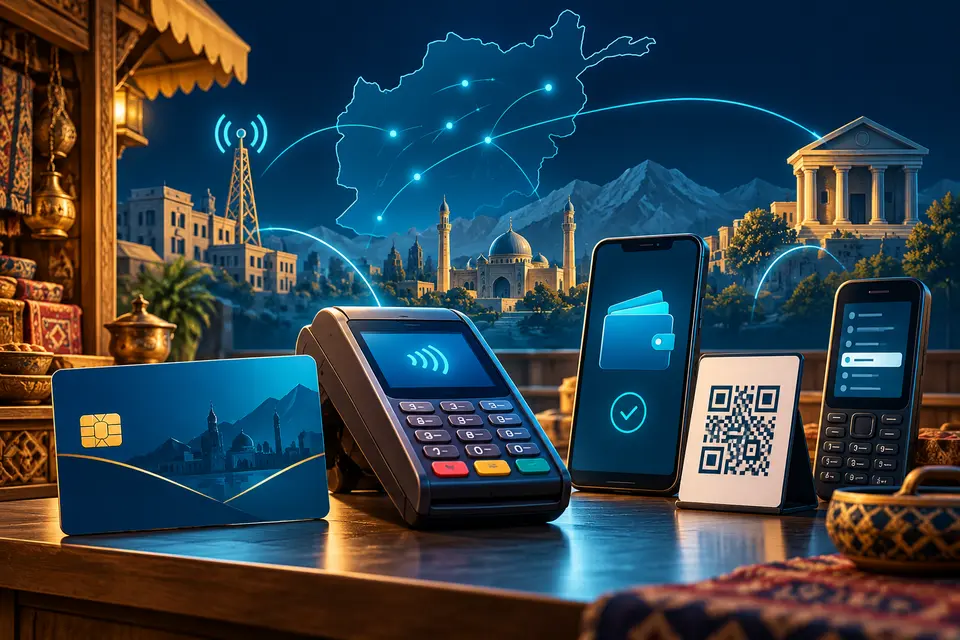
Afghanistan’s payment landscape
Afghanistan’s retail-payment infrastructure combines cash with a developing national switch, domestic AfPay cards, participating bank channels and licensed electronic-money providers. Da Afghanistan Bank describes Afghanistan Payments System as the national electronic-payment switch responsible for interoperability among banks, electronic-money institutions and other providers. APS lists domestic cards, ATMs, point-of-sale terminals, mobile applications and offline USSD access among its channels. That institutional map is useful, but it does not mean every instrument is available to every merchant, website, sector or location.
Merchants should begin with the customer and fulfilment context. A physical store with reliable terminal connectivity has different needs from an online service, a government-fee collector or a business receiving high-value bank transfers. Confirm the provider’s licensed entity, transaction channel, supported currency, settlement account, limits and service area in writing. This guide describes major relevant methods from primary sources; it is not an exhaustive acceptance guarantee and does not claim that FixPays integrates every named method.
AfPay cards and merchant terminals
APS describes AfPay as Afghanistan’s domestic payment-card scheme, issued through participating banks and electronic-money institutions under central-bank supervision. The card can be used for cash withdrawal, balance enquiry, fund transfer and purchases at supported point-of-sale terminals. For merchants, the essential question is not whether AfPay exists but whether the acquiring institution supports the intended terminal or online flow, business category and location. Confirm pricing, settlement timing, transaction limits, terminal maintenance and refund capability.
At a physical checkout, staff should rely on the terminal’s trusted approval result and the merchant receipt or back-office record. A customer-presented screenshot is not sufficient evidence that the merchant received value. Procedures should cover a lost connection, duplicated attempt, timeout, reversal, end-of-day mismatch and refund. The order or invoice identifier should be retained with the card transaction so finance can explain how a terminal payment reached the settlement report.
Mobile money, QR and USSD
Da Afghanistan Bank’s current non-bank financial-institutions page lists licensed electronic-money institutions including M-Paisa, M-Hawala, My-Money, ATOMA Pay, HesabPay, Aurum Pay, Star Pay and Las Pay. Names on a licensing list should be checked against the current legal entity and service actually proposed to the merchant. Wallets can differ in agent coverage, cash-in and cash-out, QR or payment-link functions, limits, customer verification and settlement. Compare the precise merchant product instead of treating mobile money as one interchangeable method.
APS describes offline banking access through USSD *246#, and individual licensed providers may operate their own apps or USSD services. These channels can reach customers without a smartphone or continuous mobile data, but the merchant still needs a reliable confirmation and reconciliation record. For QR payments, determine whether the code is static or dynamically connected to the order. Test wrong amounts, reused codes, delayed messages, cancelled purchases, refunds and loss of connectivity before using the channel at scale.
Bank transfers and interbank infrastructure
Da Afghanistan Bank identifies ACSS, ICPSS and the ATS real-time gross settlement system as parts of the country’s payment infrastructure. It states that ACSS connectivity includes the Ministry of Finance and private banks, and a 2026 notice says ACSS interbank activity became available around the clock. These systems operate through participating institutions. A merchant should not advertise direct access unless its own bank or payment provider has confirmed the available product and operational process.
Bank transfers can suit invoices or higher-value obligations when the payer and merchant receive dependable references. Define who creates the beneficiary details, how a payment is matched, when goods or services may be released and how incorrect or duplicated transfers are returned. RTGS is generally an interbank large-value mechanism rather than a consumer checkout button. For each transfer route, confirm finality, cut-offs, fees, currency, documentary requirements and the party responsible when the merchant ledger and bank record disagree.
International cards and cross-border customers
APS states that its objectives include links with international card schemes, and its public site reports both domestic and international card activity. That does not establish universal international-card acceptance or online acquiring. A merchant serving visitors or remote customers should confirm the precise card brands, issuing countries, transaction currencies, authentication method, merchant category and settlement route supported by its provider. Sanctions, correspondent-banking constraints and provider risk policies can also shape availability and require specialist review.
Cross-border pricing should be explained carefully. The customer may see conversion by an issuer, wallet or other intermediary while the merchant receives a different currency. Do not promise a particular exchange rate or fee unless the merchant controls and can verify it. Keep clear statement descriptors, order evidence and refund procedures. Test what happens when a card expires, an authentication step cannot complete, a customer disputes the purchase or the original currency route is unavailable at refund time.
Merchant comparison and rollout
Compare methods using the target customer group and operating environment. Useful measures include successful completion, time to usable funds, direct and indirect cost, fraud exposure, refund speed, reconciliation quality, connectivity dependence and support demand. A city retailer, nationwide distributor, online service and humanitarian supplier may reach different conclusions. Cash can remain important even when digital options are offered, so till controls and bank-deposit reconciliation should be reviewed alongside electronic acceptance rather than treated as a temporary exception.
Start with a bounded rollout and a written provider matrix. Record supported regions, customers, currencies, transaction limits, prohibited activities, settlement account, outage contacts and refund rules. Test successful payment, decline, timeout, duplicate attempt, partial fulfilment, cancellation, refund and reporting export. Keep customer-facing wording limited to methods that are genuinely live for that merchant. Review the mix after changes in connectivity, provider coverage, regulation or customer behaviour.
What it means to Merchants
Merchants evaluating Afghanistan should treat AfPay cards, licensed mobile money, USSD, bank transfers and cash as distinct channels with different confirmation and reconciliation needs. Verify the current licensed provider, exact merchant product, geographic reach, currency and sector eligibility before making an integration or availability claim. Build fulfilment around authoritative merchant confirmation, preserve order-to-settlement references and maintain tested refund and outage procedures. FixPays can assess a business request, but inclusion here does not promise that every method or merchant will be supported.