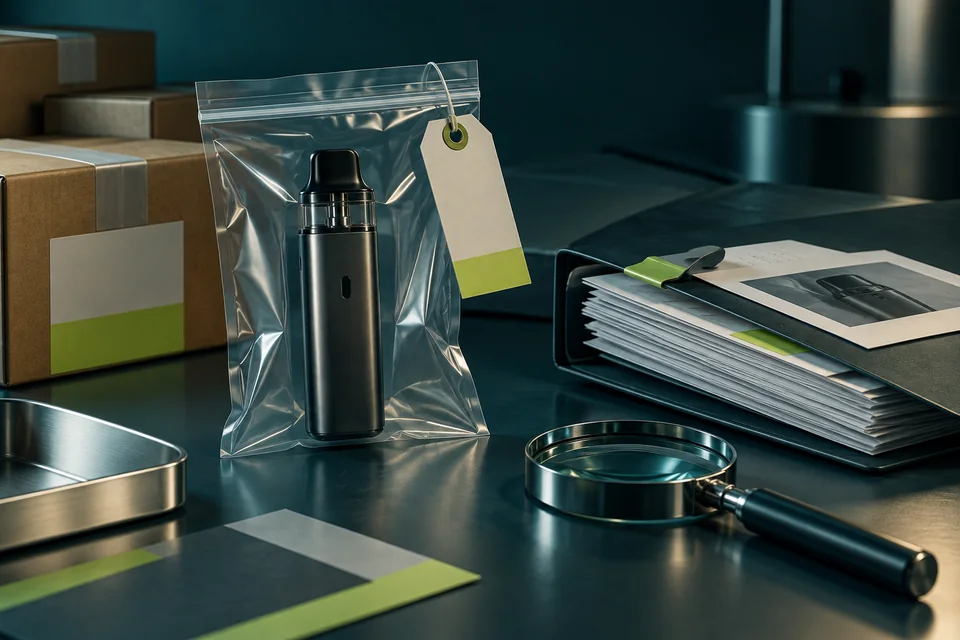
Recognise a safety report before treating it as a return
A vape customer may begin with a request for a refund and then mention a suspected reaction, overheating or another safety concern. If support records only the refund reason, the business can lose information needed by its product-safety team. The first task is to recognise that the complaint has two tracks: an appropriate customer remedy and a potentially significant product report. Neither should be reduced to the other.
In its November 2023 guidance, the United Kingdom's MHRA explains that healthcare professionals and the public can report suspected adverse reactions or safety concerns involving nicotine-containing e-cigarettes and e-liquids through Yellow Card. It identifies product details such as brand, strength and batch as valuable report information. This remains a dated source reference, not a new announcement or a complete statement of current vape-market permission. The following workflow is operational analysis for products lawfully supplied in the relevant market.
Give support a clear escalation trigger
Define the kinds of statements that require product-safety review and make the escalation route visible inside the support workflow. Staff should preserve the customer's description accurately rather than converting it into a diagnosis. A suspected association is not proof that a product caused an injury. Equally, uncertainty is not a reason to ignore the report or require the customer to prove causation before anyone reviews it.
Support should not improvise treatment advice, recommend another product to resolve symptoms or encourage continued use to reproduce the problem. Direct health concerns to appropriate professional help and follow the business's approved safety communication. The merchant's role is to record and route the report, provide verified product information and handle its commercial responsibilities. Staff need to know who takes over when the complaint falls outside that role.
Connect the report to the exact item supplied
Link the case to the order line, product variant, supplier and available batch or serial identifier. Where the customer purchased several items, establish which item the report concerns without assuming they all share the same characteristics. Ask for proportionate identifying information through a suitable channel. An order number may locate the sale, but a catalogue title alone may not distinguish different versions supplied over time.
Preserve the product page and supplier information that applied when the order was fulfilled. If a later catalogue correction changes the displayed strength or device description, retain the earlier version for investigation. Do not silently replace historical details with the current listing. The safety reviewer needs to understand what was actually offered and supplied, while finance needs to identify the corresponding transaction.
Limit sensitive information to the right purpose
A customer may volunteer extensive health information. Keep access limited and involve the privacy or legal team in deciding what the merchant needs to retain and share. The details appropriate for a clinician or regulator are not automatically appropriate for an ordinary payment dispute file. Separate the safety case from the general billing view while preserving a controlled reference between them.
Explain the purpose of any follow-up request. Do not ask for a full medical record as a routine condition of considering a refund. Where the customer is directed to an official reporting route, identify it accurately and avoid implying that the merchant has submitted a report unless it has done so. Keep the timing and ownership of any merchant report distinct from customer communication and supplier correspondence.
Keep the commercial remedy independent of suppression
A refund or replacement decision should follow the applicable rights, facts and approved procedure. It should not require the customer to withdraw a safety report, promise silence or remove a complaint. Record what the merchant has agreed to do and the related payment reference. A completed refund does not automatically resolve the product-safety question, and an open investigation does not by itself justify leaving a routine billing question unanswered.
If return of an item is necessary, obtain appropriate instructions from the responsible product and logistics teams. Do not automatically send a standard return label for a potentially damaged battery or unsafe item. Confirm the permitted handling and transport arrangements for the circumstances. Staff should communicate verified instructions and avoid asking the customer to dismantle equipment or perform risky tests to support the claim.
Look for a pattern without overstating the evidence
Review reports by product version, batch, supplier and type of concern. A cluster deserves investigation, but raw complaint counts need context such as units supplied and reporting differences. Do not publish a causal conclusion from a spreadsheet alone. The designated safety team should decide what further review, stock action, supplier communication or regulatory reporting is required under the applicable rules.
Keep the decision history visible: what evidence was available, who reviewed it, what action was taken and when the case will be reconsidered. If a broader product action becomes necessary, the existing order links should help identify affected sales. Do not wait until that point to discover that batches were never associated with fulfilment records.
Test the process with a report submitted after the refund window, a customer without an order number and a complaint concerning an item bought elsewhere. Each case needs a useful response without inventing a sale, refusing to recognise a safety concern or promising a remedy that has not been assessed.
What it means to Merchants
Vape merchants should connect suspected safety complaints to precise product and order evidence while keeping medical assessment, regulatory reporting and payment remedies distinct. Train support to escalate, preserve accurate identifiers and protect sensitive information. A refund must not suppress a report, and a report must not be represented as proven causation. This disciplined intake process supports appropriate review of lawful products without claiming regulatory approval or replacing qualified health and product-safety expertise.