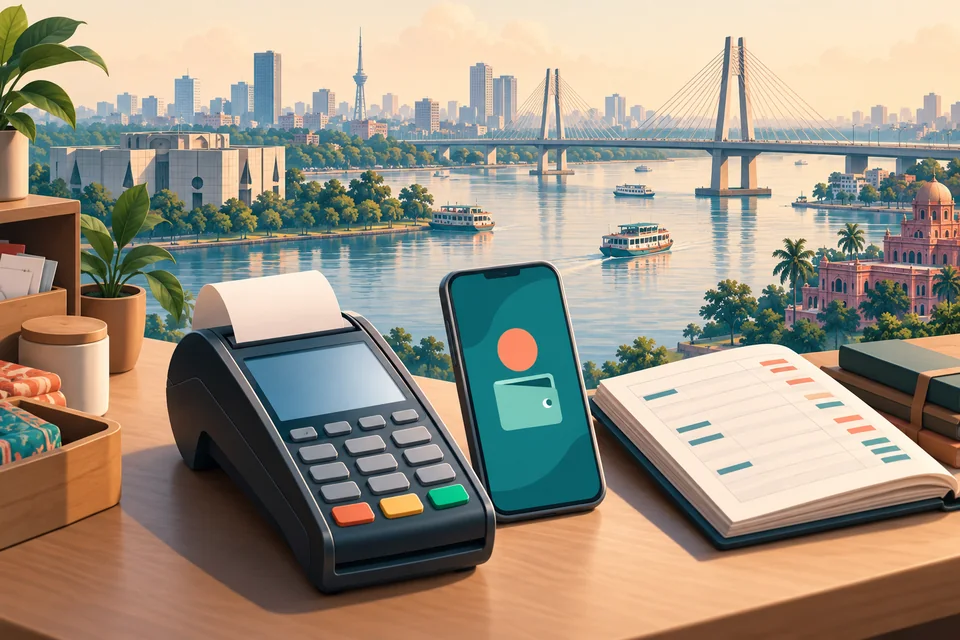
Build around the customer and collection channel
A Bangladesh payment plan should begin with the customer's purchasing journey: a shop visit, an online order, a recurring invoice or a business transfer. Each journey creates different requirements for confirmation, customer assistance and settlement. Listing more methods is useful only when the merchant can connect the resulting receipt to the correct order and explain what happens if payment or delivery fails.
This guide combines brief official descriptions of local infrastructure with independent merchant operating analysis. Provider examples describe their own services, not universal eligibility. Before integration, confirm the legal entity, product category, sales channel, customer markets and beneficiary account with the proposed partner. A method's availability in Bangladesh does not establish that FixPays offers it or that every merchant activity is accepted.
Cards, gateways and the acquiring arrangement
Bangladesh Bank's payment-system overview identifies TakaPay as the national card scheme and NPSB as infrastructure supporting participating institutions' account and card transactions. For a merchant, the practical question is which card products and channels its own acquiring arrangement enables. Domestic card acceptance and international card acceptance should be checked separately, with the actual terminal or online checkout used in testing.
Request a written description of the acquiring party, gateway, settlement account and support responsibilities. A gateway can provide the checkout interface while another institution handles acquiring. Understand who investigates a missing payment, who processes a refund and who supplies settlement reports. If a marketplace collects for several sellers, disclose that structure rather than submitting an application that describes only ordinary retail sales.
Test authorisation, duplicate submission, abandoned checkout and refund behaviour before launch. Keep the customer's order identifier alongside the provider's transaction reference. If a payment succeeds after stock has been released, assign the case for fulfilment or reimbursement. A success notification should not create a second shipment simply because it arrived twice or because a cashier also marked the order paid.
Mobile financial services and merchant accounts
bKash's merchant page offers merchant accounts with QR acceptance, counter payments and transaction history. Its application asks about identification, a trade licence and a bank account. These details illustrate a merchant onboarding process; they are not a promise of approval or a substitute for checking the current requirements for the particular business.
For mobile financial service acceptance, use the collection product approved for business activity. Ask how outlet staff receive confirmation and how head office sees the same transaction. Avoid treating a customer's phone screenshot as the final payment record. The expected merchant, amount and order reference need to match an authoritative result obtained through the service's approved interface.
Keep staff access distinct from ownership of the collection account. A departing employee should not retain the only device, credentials or recovery contact needed to operate payments. For multiple shops, maintain outlet references and a clear process for investigating money received at the wrong location. Train customer service to distinguish an unpaid order, a completed payment and funds awaiting settlement.
Bangla QR and the checkout at the counter
Bangladesh Bank's foundational Bangla QR guidelines describe an interoperable merchant-presented QR standard. SSLCOMMERZ's current Bangla QR product page provides one implementation example, with merchant reporting and integration features. The standard identifies the payment format; the selected acquirer still determines the merchant's enabled service and operational arrangements. Confirm current participation and commercial terms directly rather than relying on historic circular limits.
Inspect the displayed QR code as part of opening and closing the shop. Staff should know who may replace printed materials or change the destination account. At a busy counter, confirm the amount and merchant identity before releasing goods. Where the customer enters the amount, a successful payment for the wrong value needs a defined correction process rather than an informal cash adjustment.
Ask whether the integration supplies a transaction-specific reference and amount or relies on a static display. That choice affects reconciliation. A restaurant with many identical bills needs more than an amount-only matching rule. Test multiple simultaneous purchases, delayed notifications and a customer returning to a different cashier. Record the resolution in the order system so that the same uncertainty is not investigated repeatedly.
Bank transfers for invoices and larger payments
Bangladesh Bank describes BEFTN as supporting electronic interbank credit and debit transfers, including business and bill payments. It describes BD-RTGS as infrastructure for high-value, time-critical transfers. These are different collection contexts from a retail checkout. Obtain the bank's applicable service, processing timetable, eligibility and current limits before choosing a route for an invoice.
Issue clear beneficiary instructions and a unique invoice reference. Define how finance handles an underpayment, an overpayment or a transfer without a usable reference. Record the difference between a customer's instruction and funds confirmed as received. For a time-sensitive delivery, specify the evidence required to release the order and identify who can approve an exception.
Cross-border collections require a separate discussion with the bank or authorised payment partner. Confirm the proposed commercial purpose, currency, documentation and permitted settlement route. Do not assume that a domestic wallet or domestic QR arrangement creates an overseas merchant collection facility. Make conversion and possible deductions clear in the invoice, and agree how a returned or short payment will be reconciled.
Cash, refunds and the finance close
If the business accepts cash or cash on delivery, include those receipts in the same order reconciliation process. Record who holds the money, when it is deposited and which delivery exceptions remain unresolved. A courier reporting delivery does not by itself prove that the expected cash reached the merchant. Keep refunds and failed deliveries visible in the daily close.
For digital refunds, retain the original payment reference and use the approved reimbursement route. Verify unusual requests to send money to a different person or account. Compare payment reports with actual bank credits, separating fees, refunds and timing differences. Request a worked settlement example before signing a provider agreement so that finance can reproduce the result from the proposed reports.
What it means to Merchants
Bangladesh offers several collection routes, but the right mix depends on the merchant's customers, channel and approved operating model. Evaluate cards, mobile financial services, Bangla QR and bank transfers as distinct journeys with clear confirmation and settlement evidence. Give staff reliable status checks, reconcile exceptions and test refunds before scaling. Confirm current provider terms and sector eligibility for the actual business instead of treating a payment logo as proof of access.