Sourced news briefing
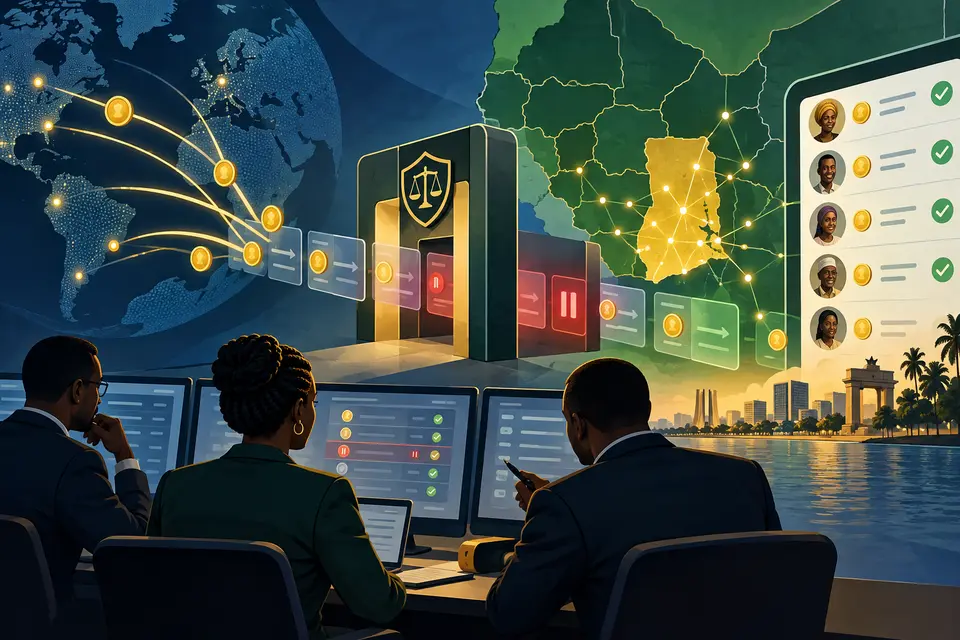
The Bank of Ghana published an enforcement announcement on 7 October 2026 concerning inward-remittance partnerships involving Flutterware Inc., Celulant Ghana Ltd. and Halges Financial Technologies Ltd. The central bank says it acted against certain payment service providers for breaches of its Updated Guidelines for Inward Remittance Services by Payment Service Providers, 2023, as amended. The public page links to the detailed notice. The action concerns named partnerships and Ghanaian regulatory requirements; it should not be expanded into a claim that every service of each company is suspended everywhere.
The announcement demonstrates that a payment provider can hold a licence or operate other products while a regulator addresses a particular activity or partnership. Merchants should rely on the detailed order, direct provider communications and qualified Ghanaian advice for exact scope, dates and remediation. The facts above are attributed to the Bank of Ghana. The analysis below is independent merchant analysis, not a legal conclusion about the named firms, and it does not imply that FixPays participates in the affected corridors.
Independent merchant analysis: Map every party in the corridor
A cross-border payment or remittance flow can involve an originator, sending institution, technical processor, settlement bank, local payment service provider, mobile wallet, agent and beneficiary institution. Merchants often see one brand while the underlying chain changes by country or method. Maintain a corridor map naming legal entities, licences or permissions claimed, contracts, currencies, settlement accounts and operational roles. A partner logo or API endpoint is not enough to understand who receives funds and who is responsible for local payout.
The map should distinguish customer purchases, merchant settlement, business-to-business transfers and regulated remittance activity. Similar technology can support legally different services. A merchant collecting payment for goods should not describe the flow as a remittance product unless that is accurate, and a remittance provider should not disguise transfers as ecommerce. Transaction purpose, sender and beneficiary information must reflect the real activity. If business operations change, reassess the corridor rather than assuming the earlier approval automatically extends.
Independent merchant analysis: Monitor regulatory and partner status
Onboarding due diligence becomes stale. Assign an owner to review regulator registers, enforcement notices, partner change communications and contract amendments. Record the date, source and scope of each check. When a notice names a company, compare the exact legal entity and activity with the merchant's route before deciding what is affected. Avoid both extremes: ignoring a relevant action and halting unrelated services based only on a headline.
Contracts should require timely notice of suspension, licence restriction, subcontractor change and material investigation where lawful. The merchant needs a contingency contact and a way to identify in-flight payments. A partner may be unable to disclose every supervisory detail, but it should explain the operational effect on the contracted service. If answers remain unclear, reduce or pause exposure within contractual and legal boundaries while obtaining qualified advice.
Independent merchant analysis: Control settlement and beneficiary changes
Corridor disruption can create pressure to send funds through a new account or entity quickly. Treat beneficiary and settlement changes as high-risk events. Verify instructions through an independent channel, confirm the legal relationship, screen the destination and update the corridor map before movement. Do not route through an unrelated business, personal account or misleading descriptor to keep volume flowing. A workaround that hides the actual service can increase legal, fraud and recovery risk.
Finance should reconcile amounts accepted, amounts sent into the corridor, fees, foreign exchange, local payouts, returns and balances held when the route changes. Segment by provider and country so exposure is visible. Customer support needs truthful status messages and should not promise a payout time while funds are under review. Where refunds are due, use an authorised route and preserve the connection to the original customer transaction.
Independent merchant analysis: Prepare a lawful continuity plan
A continuity plan should list alternative regulated partners that have completed due diligence, not unverified names collected during an incident. Test technical integration, data fields, sanctions and financial-crime controls, settlement, customer notices and reporting before activating a route. Diversification can reduce concentration, but multiple opaque corridors create more risk rather than less. Each route requires ownership and reconciliation.
After an enforcement event, review the merchant's own representations to customers and providers. Correct unsupported claims about speed, coverage or local access. Preserve relevant records and cooperate with lawful requests through the responsible counsel or compliance team. The goal is not to decide whether a named provider is guilty; it is to ensure the merchant understands its dependencies, protects customers and avoids amplifying an unsupported or prohibited flow.
Independent merchant analysis: operating review
Merchants should distinguish a regulator's effective date from the date their provider implements operational restrictions. A notice may require immediate action, a phased wind-down or another specified response, while customer balances and pending transfers still need controlled treatment. Record both dates and seek written instructions for transactions initiated before the change. Examine whether the merchant owes notices to customers or counterparties and avoid announcing a remedy that has not been confirmed. The treasury plan should identify trapped liquidity, prefunding and unsettled fees across every participant. If an alternative corridor is approved, reconcile old and new routes separately until no residual balance remains. Senior review should challenge incentives to keep selling into a corridor when payout certainty has deteriorated. Compliance, operations, finance and customer support should agree one factual incident record so public messages, provider questions and internal decisions do not diverge. Platform merchants should determine whether sellers, payees or customers rely on the affected route and prevent new obligations that cannot be discharged. Review beneficiary complaints for common failed destinations or inconsistent status codes. Preserve provider notices and portal exports before access changes. Confirm how personal data may be transferred to a replacement partner and avoid copying complete files without a lawful purpose. Where foreign exchange was already booked, document who bears rate movement or reversal costs. Do not net unrelated merchant funds informally to cover a corridor shortfall. Management should approve the recovery sequence, customer priority and communication cadence, with legal review where rights or regulatory duties are uncertain. Close the incident only after every in-flight transfer has a final status, residual funds reconcile and affected customers receive the promised outcome. Retain lessons for future corridor onboarding.
What it means to Merchants
Merchants with Ghana-linked payment or remittance dependencies should identify whether the Bank of Ghana action touches their exact legal entity, partnership and service. Map every corridor participant, verify regulatory status from primary sources, reconcile in-flight funds and treat settlement changes as controlled events. Maintain pre-reviewed alternatives without concealing the real transaction purpose. The announcement is jurisdiction- and activity-specific; it does not prove that all services of a named company are unavailable or that FixPays has any role. Record the regulator page and review date in the corridor file. Match provider trade names to legal entities. Separate confirmed facts from press summaries. Escalate unexplained payout delays. Verify new beneficiary instructions independently. Keep transaction purpose accurate. Preserve customer and settlement references. Review balances held with each participant. Test contingency reporting before activation. Avoid emergency onboarding shortcuts. Seek Ghanaian legal advice for scope questions. Train support not to speculate about enforcement. Reassess corridor concentration quarterly. Document decisions to continue, restrict or pause. Review corridor, partner, licence, settlement, beneficiary, remittance, controls, Ghana, reconciliation, continuity, governance, ownership, training, testing, escalation, reporting, privacy, security, contracts, customer-impact, exceptions, recovery, documentation, changes, outcomes, responsibility, timing, support, audit, evidence, scope, limits, refunds with accountable teams before launch.