The announced development
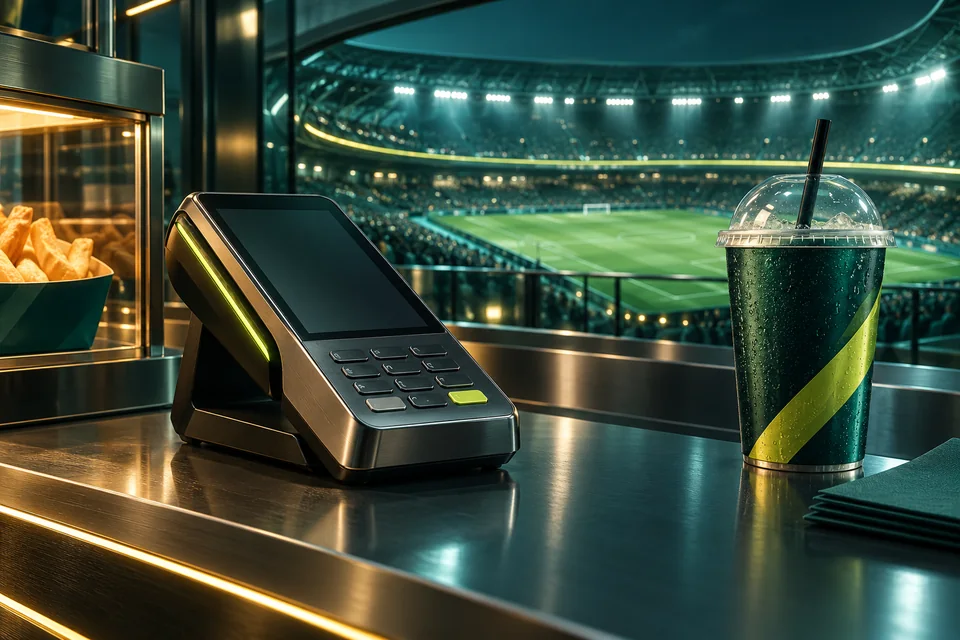
Adyen announced an extension of its partnership with FC Bayern München on 12 October 2026. The collaboration began in 2023 and covers stadium commerce and online sales. According to Adyen, average stadium payment processing time fell from 30 seconds to 27 seconds following the platform change, supporting approximately 10 percent more kiosk transactions on match days.
The release describes centrally managed mobile terminals, international payment options and a terminal donation feature. These are results and capabilities reported for this particular customer relationship. The figures are not a promise that another venue will achieve the same improvement, and the announcement does not isolate every operational factor that contributed to the outcome.
Merchant analysis: a short window changes the economics
A stadium concession operates under a constraint that many ordinary checkout comparisons overlook: customers have a limited period in which they are willing to purchase. Improving payment speed may be particularly valuable when the alternative is a supporter abandoning the queue before play resumes. The relevant commercial measure is therefore completed purchases during the available window, not simply the average duration of a payment request.
Other businesses encounter similar conditions. A theatre bar faces an interval rush, a conference café serves customers between sessions and a transport kiosk trades around departures. Each should identify its own constrained periods before estimating the benefit of faster payments. Saving seconds at an empty counter has a different economic value from saving seconds where a queue repeatedly prevents willing customers from buying.
A merchant should also identify the actual bottleneck. If food preparation takes longer than payment, a quicker terminal might have little effect on completed orders. If customers wait while staff locate products, stock organisation may matter more. Measuring the full journey prevents payment technology from receiving either excessive credit or unfair blame for the performance of an entire service operation.
Separate processing speed from customer waiting
The reported stadium figures provide a useful prompt to improve measurement. Merchants should define when a timing exercise starts and ends: order entry, presentation of a payment method, authorisation response or receipt delivery. Different definitions can produce very different numbers. A useful internal dashboard keeps payment latency distinct from total customer waiting time and total service time.
Average performance alone can hide the moments customers remember. A small number of very slow transactions may block an otherwise efficient counter. Record the distribution of completion times, the frequency of retries and the number of customers who leave before ordering. Where feasible, observe those measures during the busiest comparable periods, because a quiet morning test is a poor substitute for an event rush.
Comparisons should also account for basket composition. A customer buying one drink is different from a group ordering several meals. Staffing, product availability and event attendance should be recorded alongside payment data. The objective is not an elaborate statistical exercise for every small venue, but an honest assessment of whether a change improved the experience under sufficiently similar conditions.
Mobile equipment needs an operating plan
Moving payment acceptance closer to a customer can reduce unnecessary walking and enable sales away from fixed counters. It also creates practical responsibilities: devices need to be charged, allocated, recovered and secured. Merchants should assign those duties explicitly. A fleet of mobile terminals can lose its advantage if staff begin a busy session with depleted batteries or uncertain access credentials.
Connectivity should be tested in the actual trading environment. An apparently strong signal in an empty venue may not describe performance when the space is full. Operators should understand their provider's supported connection options and incident procedures. Any ability to accept transactions during an outage must be confirmed in the specific agreement and configuration, rather than assumed from a general product description.
The human workflow matters just as much. Staff should be able to identify a successful sale, an unresolved attempt and a clear decline without guessing. When a customer taps twice after an uncertain response, the team needs a reliable way to check the original outcome. Written procedures and brief practice sessions before an event can prevent hurried decisions when queues are longest.
International demand requires selective payment choices
An international audience can justify additional payment methods, but a large method count is not itself a conversion strategy. Merchants should examine where visitors come from, which devices they use and what their own abandonment data suggests. The useful question is whether a relevant customer can complete a purchase easily, with terms and currency information they understand.
A venue with tourists and an online merchandise store may need different priorities for each channel. At a physical counter, recognisable signage and trained staff can matter. Online, clear delivery availability and a functional mobile checkout may matter more. Adding a method will not solve an address form that rejects legitimate customers or shipping information that appears too late.
Refunds should be included in every international acceptance decision. Support teams need to locate transactions across channels and explain the refund route accurately. Customers should not be asked to provide sensitive payment information through informal messages. A merchant expanding acceptance should ensure that after sales service remains understandable for people who may have left the country by the time they need help.
Donation prompts and reporting deserve separate care
An optional donation at checkout introduces a second customer decision during a time sensitive sale. Merchants considering such a feature should make the choice clear and avoid creating pressure or confusion. They should test whether customers understand the recipient and can decline easily. A socially valuable initiative still needs a careful interaction design, particularly when people are rushing.
Accounting should distinguish the underlying sale from any donation and explain how reversals or errors are resolved. Teams should verify the applicable fee arrangement rather than assuming that terms reported for one partnership apply elsewhere. Clear records protect the merchant, the charitable recipient and the customer when somebody later questions an amount.
For the wider payment project, set a review period spanning several comparable events. Combine transaction counts with queue observations, staffing costs, failed attempts and customer complaints. Look at net contribution rather than gross volume alone. If additional sales require disproportionate labour or generate unresolved errors, the apparent improvement needs further work. A successful rollout should be repeatable without depending on a few unusually experienced employees.
Stock planning should accompany any capacity improvement. If quicker payments allow more orders but popular items run out earlier, customers may simply encounter a different obstacle. A venue can compare queue observations with stock depletion times to decide whether preparation and replenishment need adjustment. It should also consider the physical handover area: completed orders still require space and clear identification. These observations help determine whether an investment has increased the whole operation's useful capacity, rather than shifting congestion a few metres beyond the terminal. The payment team should share findings with catering managers before the next event.
What it means to Merchants
FC Bayern's reported experience shows why payment performance belongs in the operational planning of venues with short, intense sales periods. Merchants should use the case as a prompt to measure their own queues, payment outcomes and service bottlenecks, then test changes under realistic conditions. Faster processing becomes commercially meaningful when it produces more accurately fulfilled orders and a better customer experience. Confirm local capabilities, train staff for uncertain outcomes and evaluate the complete cost of service before treating another business's results as a forecast for your own operation.