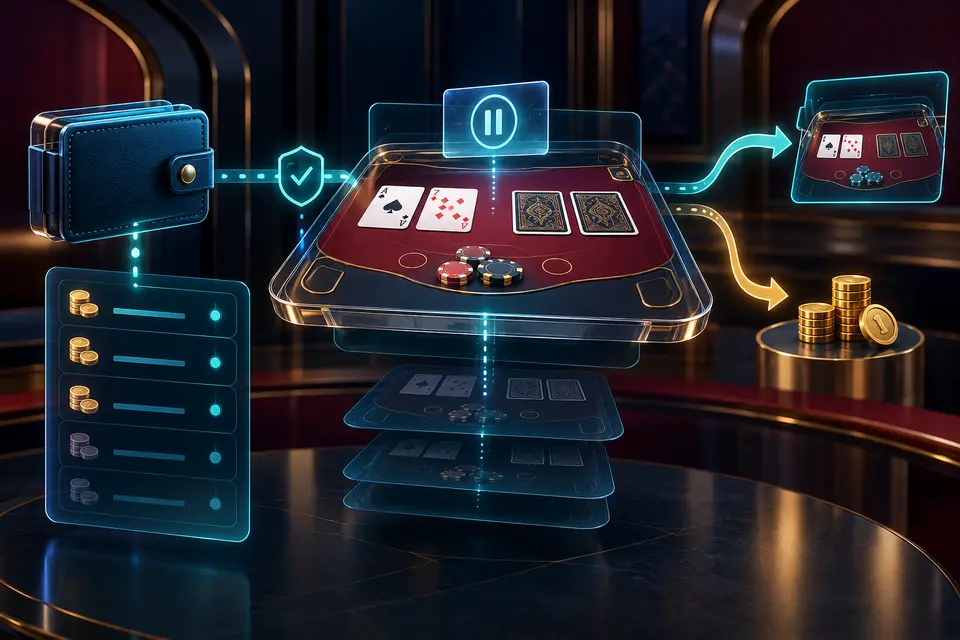
Classify the interruption
The UK Gambling Commission’s remote technical standard says customers should be treated fairly when play is interrupted and told how interruptions are handled. Its guidance distinguishes an accepted gamble whose outcome no longer depends on the customer, a single-stage event interrupted before an outcome, a stateful game that may be restored and multiplayer cases needing fair treatment. This British standard is a regulatory example. Operators should confirm the exact rules, licence and game scope applying to them.
Keep payment and game ledgers linked
A card deposit, player-wallet balance, stake deduction, game state, win and withdrawal are different records. Use stable identifiers to connect them without collapsing them. When service fails, staff should see whether the deposit completed, whether a stake was accepted and whether an outcome was generated. Returning a stake to the player ledger is not the same as refunding the original card deposit. Confusing those actions can create duplicate value or leave the customer underpaid.
Restore or void consistently
For stateful games, record the last valid state and the evidence supporting restoration. For a void, record the rule, stake amount, operator action and customer notification. Manual intervention should require authorised roles and leave an audit trail. Progressive values and multiplayer effects need specific handling. Do not improvise outcomes from screenshots or support chat. Where the system cannot establish state reliably, escalate under approved policy instead of selecting the result most convenient to the operator.
Explain status to customers
Publish interruption policies in clear language and make support able to identify an unresolved round. A customer should not be told simply that the payment succeeded when the question concerns a missing stake or game outcome. Provide a case reference and expected review route without promising a result before evidence is checked. If an account restriction or identity review also applies, explain that separately so one issue does not hide the other or prolong a payment complaint unnecessarily.
Test recovery and reconcile incidents
Run controlled failure tests for dropped connections, duplicated callbacks, database delay, partial service outage and recovery after restart. Reconcile total stakes accepted, outcomes, voids, restored states and wallet adjustments for the incident window. Compare provider and internal timestamps carefully. Review complaints and disputes after the event to find customers whose ledger was technically corrected but poorly explained. Report material incidents as required and retain the evidence for the applicable period.
Operational implementation
Game suppliers and operators should agree the authoritative source for state and the interface used to report recovery. Contract terms should address incident notice, data retention, testing, customer remedies and access to logs. An operator cannot explain customer balances if a supplier supplies only a final total without round detail. Before release, trace a test round through the supplier, player wallet and operator report, then verify that a void or restored outcome appears consistently everywhere.
Payment disputes following an interruption need careful evidence. The card issuer sees a deposit, while the customer may complain about a missing game outcome. The merchant should not present the deposit authorisation as proof that the game was delivered fairly. Provide the relevant account credit, stake, interruption, remedy and communication records under provider rules. If the deposit was later withdrawn or used in other play, keep that chronology clear and avoid cherry-picking only favourable events.
Post-incident review should cover more than uptime. Count affected rounds, total stakes, automated and manual corrections, customer contacts, repeated credits, unresolved cases and time to complete reconciliation. Examine whether monitoring detected the issue before complaints. Change recovery logic or customer guidance when evidence supports it. A supplier fix should be versioned and retested. The objective is predictable fair treatment and explainable balances, not simply reopening the game as quickly as possible.
What it means to Merchants
Online casino merchants should connect interruption policy to verifiable game state and the player wallet. Determine whether a stake was accepted, restore or void under the applicable rule, and keep any card refund distinct from a wallet adjustment. Give customers clear status and preserve an authorised audit trail. Test recovery before a real outage and reconcile the full incident afterward. The UK standard is not universal, so operators must confirm market-specific licensing, technical and customer-funds duties. Assign a technical incident owner and a customer-remedy owner. Agree how game suppliers and the operator exchange authoritative state. Keep clocks synchronised and document time-zone handling. Review access to manual balance tools and alert on unusual adjustments. Customer messages should state what was restored, voided or remains under review. Finance should understand whether a correction affects revenue, liabilities or payment settlement. Risk teams should examine abuse without presuming every reconnect is malicious. Include progressive jackpots and multiplayer scenarios in supplier testing where relevant. If evidence is incomplete, use the documented fair-resolution process and record the reasoning. A resilient operation can explain the difference between money entering the account, a stake entering a game and value returning to the customer. Include these controls in supplier acceptance tests and change approval.